
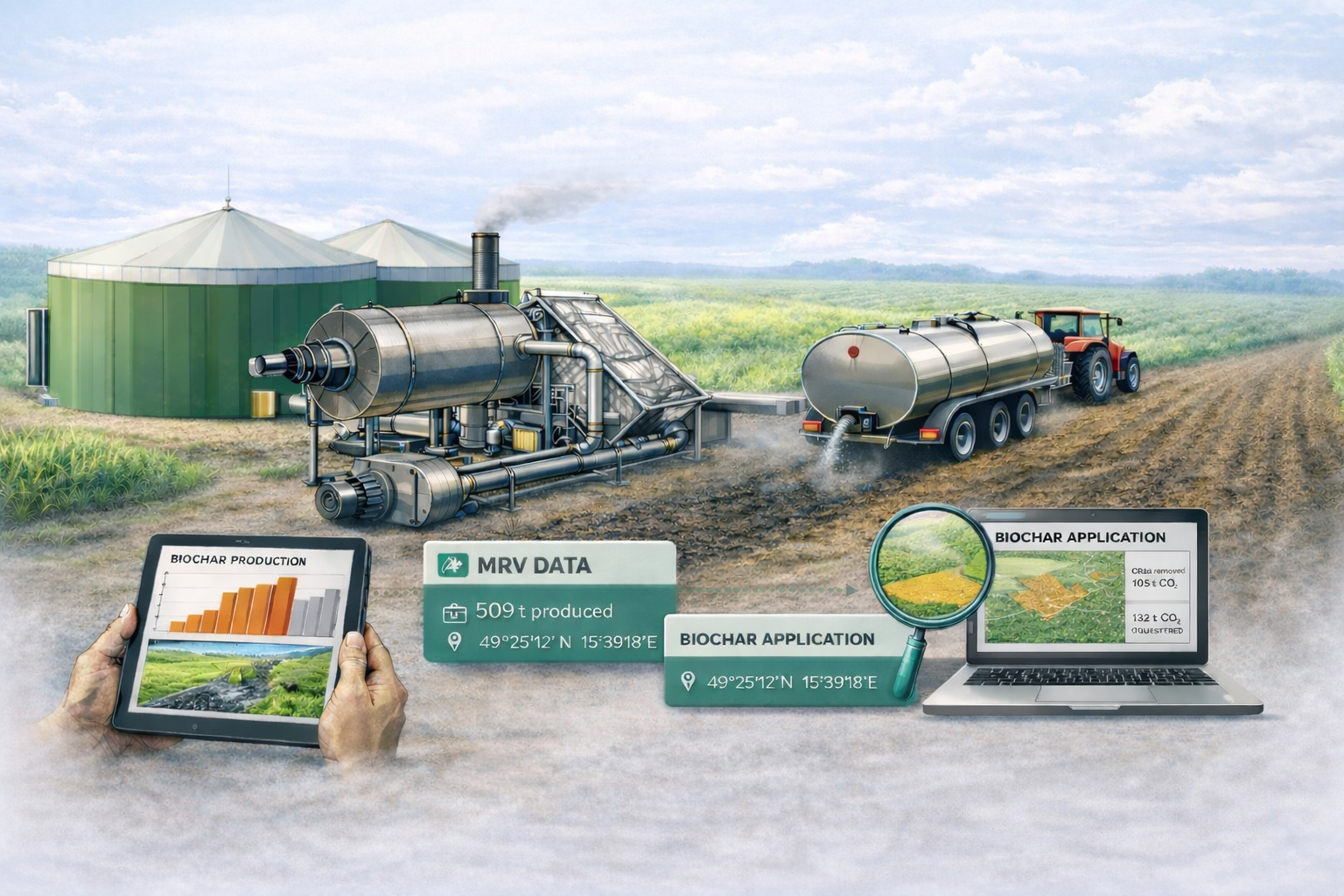
Transforming Biogas Plants
into Carbon Sinks
Our innovative solution transforms biogas plants into permanent carbon removal facilities. Residual biomass from digestate is converted using the KARBOTECH technology through pyrolysis into stable carbon (biochar) incorporated into the soil where it remains for centuries.
Why now
Since 2026, the European Union has certified permanent carbon removal under a single set of rules. Biochar is one of the three recognised pathways, and the biogas plant is its natural home.
A European framework
Regulation (EU) 2024/3012 on carbon removal certification (CRCF) defines a tonne of permanently removed CO₂ and how it is measured, verified and recorded. The first methodology for permanent removals has applied since May 2026.
Biochar among the recognised pathways
The methodology covers direct air capture, capture of biogenic CO₂ with geological storage, and biochar applied to soil. The carbon in biochar stays in the soil for centuries.
The biogas plant as a ready foundation
A carbon removal project needs a steady supply of biomass, a link to farmland and a staffed technical operation. A biogas plant already has all of this, and KARBOTECH adds pyrolysis. The plant gains a new product – certified carbon removal – and the fields receive a better fertiliser.
From Biogas Plant
to Carbon Sink
Our innovative solution transforms biogas plants into permanent carbon removal facilities. Residual biomass from digestate is converted using our KARBOTECH through a process of pyrolysis into biochar. This is then mixed with the liquid part of the digestate and incorporated into the soil, where it will remain for centuries as soil carbon.
Regenerative Soil Conditioner
When organic nutrients, selected soil bacteria, and fungi are added to biochar, the result is MicroCHAR® regenerative conditioner. Applied during sowing, it provides plants with nutrients as well as natural protection against pests and stress.
Three Types of Biogas Plant
A normal biogas plant
Anaerobic decomposition of plant biomass or waste produces biogas, which is burned in an engine with a cogeneration unit.
The residual biomass with water (digestate) is deposited into a storage tank and transported to the fields at the appropriate time.
A better biogas plant
A separator, dryer, and KARBOTECH device are placed behind the fermenter, converting residual biomass from the digestate into biochar.
The biochar is returned to the liquid part of the digestate, where it binds nutrients, which it gradually releases into the soil.
The best biogas plant
Biochar, organic nutrients, bacteria, and fungi are used to produce the regenerative soil conditioner MicroCHAR®.
The biotic component helps to regenerate soil life and thus natural fertility.
KARBOTECH one
Explore the pilot installation — real MRV data, process chain, and independent Isometric validation.
CDR Infrastructure
From one pilot to a pan-European network. Discover the scaling roadmap and MRV framework.
14,000+ biogas plants
Across the EU, more than 14,000 biogas plants already have the biomass, the farmland and the operation a carbon removal project needs. Each is a potential node of the KARBOTECH network.
Ready to transform
your biogas plant?
Contact us to learn how KARBOTECH can generate new revenue streams for your facility while contributing to permanent carbon removal.
email@a-carbon.eu