
Transforming Biogas Plants
into Carbon Sinks
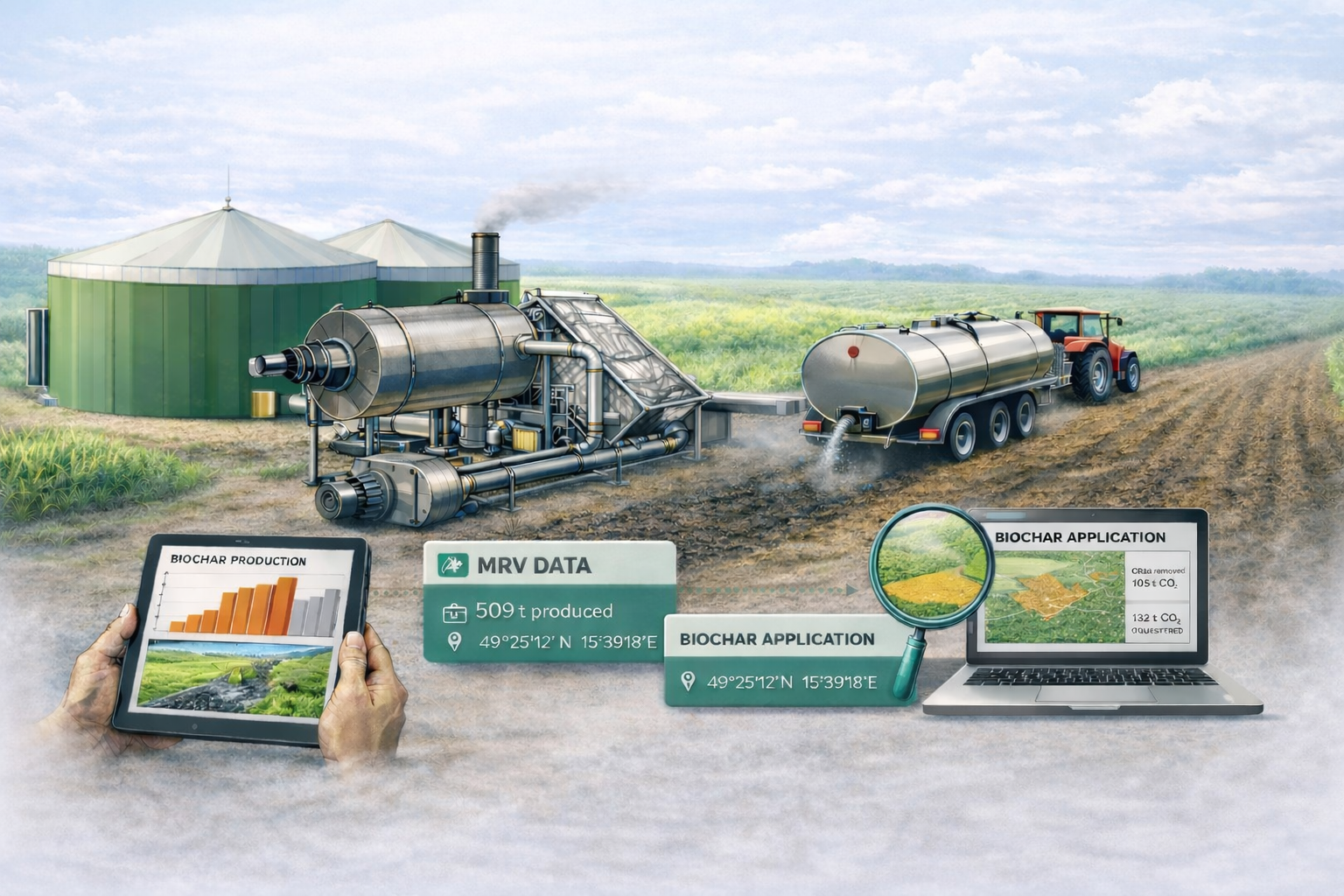
Our innovative solution transforms biogas plants into permanent carbon removal facilities. Residual biomass from digestate is converted using the KARBOTECH technology through pyrolysis into stable carbon (biochar) incorporated into the soil where it remains for centuries.
From Biogas Plant
to Carbon Sink
Our innovative solution transforms biogas plants into permanent carbon removal facilities. Residual biomass from digestate is converted using our KARBOTECH through a process of pyrolysis into biochar. This is then mixed with the liquid part of the digestate and incorporated into the soil, where it will remain for centuries as soil carbon.
Regenerative Soil Conditioner
When organic nutrients, selected soil bacteria, and fungi are added to biochar, the result is MicroCHAR® regenerative conditioner. Applied during sowing, it provides plants with nutrients as well as natural protection against pests and stress.
Three Types of Biogas Plant
A normal biogas plant
Anaerobic decomposition of plant biomass or waste produces biogas, which is burned in an engine with a cogeneration unit.
The residual biomass with water (digestate) is deposited into a storage tank and transported to the fields at the appropriate time.
A better biogas plant
A separator, dryer, and KARBOTECH device are placed behind the fermenter, converting residual biomass from the digestate into biochar.
The biochar is returned to the liquid part of the digestate, where it binds nutrients, which it gradually releases into the soil.
The best biogas plant
Biochar, organic nutrients, bacteria, and fungi are used to produce the regenerative soil conditioner MicroCHAR®.
The biotic component helps to regenerate soil life and thus natural fertility.
KARBOTECH one
The first operational KARBOTECH installation. Real MRV data, verified carbon removal, and a proven model for scaling biochar production at biogas plants.
CDR Infrastructure
A network of KARBOTECH units across biogas plants forms a distributed CDR infrastructure — delivering measurable, verifiable, and permanent carbon dioxide removal at scale.